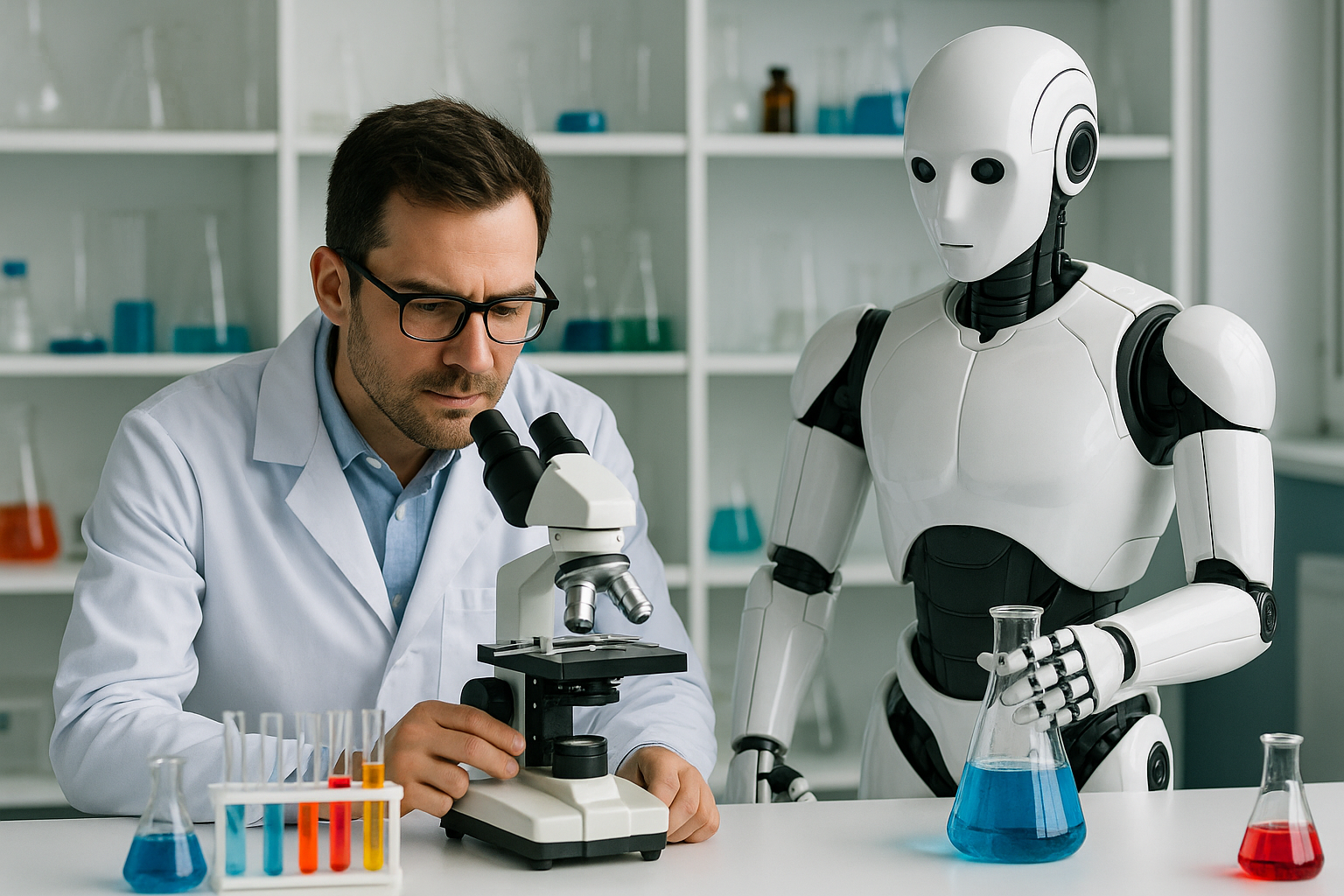
Science is incredible. The practice of observing the world around us, stating hypotheses, designing experiments, collecting data, analyzing results, and sharing the work with peers has propelled our civilization forward in countless ways. Ancient Babylonian astronomers tracked the movement of celestial bodies and used this information to refine their calendar’s accuracy and generate the first planetary theory in human civilization. During the Islamic Golden Age, which spanned the 8th century to the 13th century scholars devised experiments to understand the characteristics of light and vision and fathered algebra. Newton, Galileo, Da Vinci, and countless other Renaissance scientists, propelled by the deluge of shareable information made possible by the printing press and practice within a newly formalized framework called the scientific method, discovered and created even more scientific advances. The Enlightenment, Industrial Revolution, and Information Age have all served as additional catalysts, amplifying the speed and magnitude of our collective scientific understanding. AI has the potential to equal or surpass these force multipliers of the past and vastly expand our ability to observe, understand, and engineer our world.
Alphafold – Predicting the shape of life
I was inspired to write this post after watching a great interview with Max Jaderberg and Rebecca Paul of Isomorphic Labs, a drug discovery company spun off from Google DeepMind and now part of Google’s parent company, Alphabet, Inc. In the interview, host Professor Hannah Fry and her guests discuss the potential for AI in drug discovery, the way humans and AI collaborate in the drug discovery process today, and what future AI capabilities might unlock for scientific understanding.
A foundational technology to Isomorphic’s founding and approach to drug discovery is AlphaFold – an AI program that was built by Google DeepMind with the goal of being able to predict a protein’s 3D structure from it’s amino acid sequence. Proteins are fundamental biological molecules that are responsible for a vast amount of activity that occurs in living beings, from transporting molecules to carrying out the chemical reactions that take place in cells. It’s fairly rudimentary to determine a protein’s amino acid sequence, but until AlphaFold, it was extremely difficult and labor intensive to determine the 3D structure of a protein. Determining a protein’s structure in a lab using techniques like X-ray crystallography, where scientists crystallize a protein, blast it with X-rays, then analyze the diffraction pattern of those X-rays, can take months or years and cost several hundred thousand dollars.
AlphaFold enabled highly accurate estimation of a protein’s 3D structure, placing first in a competition designed to assess this exact capability. AlphaFold 2 scored even higher, and AlphaFold 3 extended the scope of the system to complexes created by proteins with DNA, RNA, ligands, and ions. In recognition of this incredible work, Sir Demis Hassabis and John Jumper of Google DeepMind shared half of the 2024 Nobel Prize in Chemistry for AlphaFold 3.
From structures to molecular candidates
Why is determining a protein’s structure so crucial for drug discovery? Because drugs work by fitting into a protein’s 3D structure like a key fitting into a lock. As explained in the interview, this geometric reality has been previously willed into existence experimentally, as medicinal chemists create candidate molecules and test their ability to interact with the target protein in a successful manner to mitigate a disease mechanism.
Thanks to AlphaFold 3, this can now be done in-silico — on a computer.

Screenshot of AlphaFold 3 platform showing a candidate molecule’s 3D structure interacting with the grayed out 3D protein structure (left) and the molecule’s 2D chemical structure (right)
By previewing the molecule’s predicted interactions with a protein, and being able to make changes within the platform, scientists can understand the candidate molecule’s likelihood of success and tweak it in seconds, instantly viewing the new result.
It’s vitally important to understand that these tools do not replace the need for experimentation in the real world – the “wet lab.” What they do however, is allow for much more expansive and time-efficient experimentation virtually, making precious experimental effort in the real world more valuable and efficacious. If you’re going to spend time in a lab testing molecules, by using systems like AlphaFold 3, you can gain additional confidence that the molecule you’re working on has a higher probability of success than if you had worked without a pre-validation step of testing it virtually. Does that mean that specific molecule will surely work out, execute the exact mechanism needed to treat a disease, and go on to be successful in clinical trials? No – there’s no guarantee of success. But if scientists can use AI tools to make each “shot on goal” more likely to succeed, it follows logically that they could drastically shorten the time needed to arrive at a successful outcome.
AI-Human Collaboration

In five years time, doing drug discovery without AI will be like doing any sort of science without math.
– Max Jaderberg, Chief AI Officer, Isomorphic Labs
There are lots of exciting takeaways from this interview – who wouldn’t be excited about the hyperbolic prospect of curing all diseases in 10 years – but the most exciting part to me is thinking about using AI to accelerate the speed of scientific discovery and making intractable problems tractable.
Chemical space, basically the number of theoretical possible molecular structures that exist, is frequently cited to be around 10^60 structures – that’s 10 with 60 zeroes after it. To put that in perspective, if each of the 10^20 grains of sand on Earth was in fact it’s own Earth with 10^20 grains of sand on it, then each of those “grainchildren” would also have to be their own Earth, with their own 10^20 grains of sand for us to equal the vast size of chemical space. When Isomorphic uses groundbreaking technology like AlphaFold 3 as a wayfinder in that vast space, they have the potential to massively speed up the process of bringing life-changing treatments to market.
AI for Science = AI for Good
Strong opinions about AI are forming rapidly as it works its way into the social, economic, and technological facets of our society. Pew Research recently surveyed AI experts and the general public about their views on AI. There are lots of interesting datapoints in the survey, and I plan on doing a full post on it soon. But I want to draw attention to a specific line of questioning related to AI having a positive or very positive impact in certain areas.

There is one standout category from this line of questioning – Medical Care. A huge majority of AI experts believe that AI’s impact will be positive in the domain of medical care, and a whopping 44% of the general public does as well. In a sea of discontent, hype, doom, and fear, using AI to increase our ability to lead healthier, longer lives less affected by disease sounds like a pretty good future for us all to rally around. Companies like Isomorphic are leading the charge, and open source breakthroughs, like the recently announced Boltz-2 AI model that predicts drug-binding affinity (another key consideration for drug design) will help accelerate progress. I’m confident that this slice of the future is bright, but we’ll have to navigate choppy waters during the journey there.
Timing is everything
Accelerating the drug discovery process is a worthwhile endeavor, and I’ll be following and rooting for the companies looking to do so. But the results from these efforts will still take time – very likely in the 5 to 10 year time frame before compounds come to market from Isomorphic or other players in the space. In that time, I really worry about the negative impacts that AI could have, from job displacement, to personalized election misinformation, to enabling a further retreat into socially isolated lives powered by hyper-optimized generated content. These negative potential outcomes could further entrench views about AI, and even erode goodwill that has built up for more generally accepted altruistic applications of AI, like using it to supercharge scientific progress.
In a world where negative and polarizing news drives the most engagement, and the networks we use to consume that news prioritize engagement above all else, it’s an uphill battle to get people to pay attention to the potential that AI has to accelerate our understanding of the world and our ability to engineer a better future. It’s also difficult to expect people to have a nuanced view of AI technologies when they are frequently lumped together as a monolith rather than viewed as separable efforts that have both obviously good and obviously bad use cases. That’s part of the mission here at Clearly Intelligent – to enable my audience to understand and form coherent and nuanced views on the promise and perils of AI.
I’ll end this post with a great graphic I came across recently that charts the pace of scientific progress throughout human history. It’s truly incredible to look at how far we’ve come from our earliest days as a species, and how rapidly we have been able to advance in recent history. As we enter the age of abundant intelligence, we have the opportunity to point it at the most pressing problems we still face, and I hope we use that power as a force for net good.

Leave a Reply