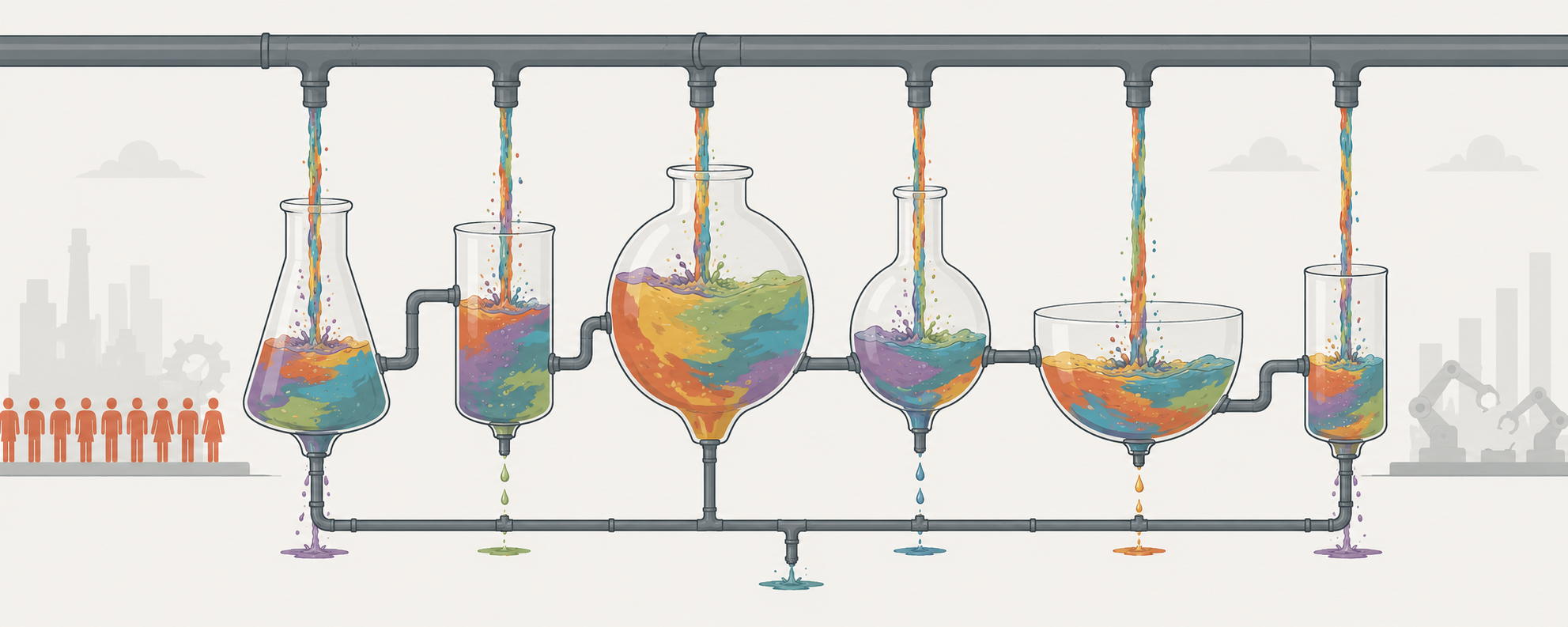

I want AI to go well. You should too. Read the summary – then read the rest.
- AI could be very good for humanity, but in order to make that happen, we have to be intentional about choices we collectively make in the next few years.
- We should focus on making society great, not simply making society rich.
- Doing that is going to take serious imagination and a rethinking of the social and economic systems that govern the world today.
- If we do this correctly, we can steer ourselves toward an incredible future.
- If we don’t, we risk locking in and worsening the things that keep our world from reaching its full potential today.
- “Getting AI right” requires many things going well. In this post I argue that getting the balance of the speed of AI labor diffusion into the economy and the economy’s ability to reabsorb displaced labor back into the economy is one of the most important considerations.
- My political alignment and AI use disclosure are at the bottom of this post. I don’t want either of these aspects of the post to dissuade you from reading, but I recognize these things are important to some people, and value good faith and transparency very highly, so I’m providing them for context. TL;DR – I’m left of center and I used AI to help research, create images, visualizations, and code, and to copy edit. The prose is mine.
- I like being a consultant because I like solving problems. I’m currently pro bono in solving the very important problem of “How can we make sure AI goes well?” If you like what I’ve written, and are interested in helping me turn pro in this area, or know someone who might be, DM me here.
Universal High Income?
I’ve been thinking about writing this post for awhile. In fact, the entire existence of Cleary Intelligent is basically predicated on the ideas contained within this post. I’ve debated on waiting until I had a bigger audience, waiting until a certain level of AI capabilities appear, or waiting until there was a clearer plan from the institutions of the world to keep society intact while we navigate the birth of capable AI and its diffusion through society. I’ve decided I no longer want to be stuck in the waiting place.
What really compelled me to take on this gargantuan effort right now was Elon Musk, the world’s richest man, who the prediction markets think is more likely than not to become a trillionaire before 2027, sending the following post on the site he purchased in order to bend the world to his whims.
Is there a zero percent chance that this happens? No. I don’t really think there’s a zero percent chance of anything happening. Would basically everything about how the modern world works today have to change in order for this happen? Yes. Does this mean that the chances of this happening are vanishingly low? Yes.
I’m generally a pretty open-minded person, and can employ a lot of imagination when considering different ways the future might look. I think it’s probably ok to be skeptical that the outcome Elon’s envisioning here is the default result for society when AGI , and then ASI, is achieved.
This post might read to some as a bit pedantic, or condescending – but that isn’t the intent of it. I’m going to try and explain my thoughts as I would to a young child, or a golden retriever. The goal of speaking so directly and at times plainly, is to establish some set of baseline definitions, ideas, axioms, etc. that undergird my worldview. I’d welcome any and all arguments, debates, or quibbles that arise from this post, but since this is a one-way communication medium, I’ll do my best to clearly explain how I view the world and the challenges we seem likely to confront over the next 25+ years.
What is an economy?
I’m not an economist, though sometimes I wish I took more than just microeconomics in college. Whether you’re an economist, or only trust thoughts about economics that come from economists, or hate economists, or think the economy is made up, or think that there’s no ethical consumption under capitalism, or think taxation is theft, I don’t really care. I’m not here necessarily to disabuse you of any of these notions, and you’re free to have them. That’s one of the great many freedoms afforded to us – believe what you want to believe. One of the great many freedoms of being a neophyte writer is I can dump my thoughts onto a canvas and hope others take them, wrestle with them, argue with them, and share them.
Plainly put, in my own terms, an economy is an organized system that has as its primary goal the production and distribution of goods and services. As humans transitioned from hunter-gatherers to an agriculture-based method of survival, around 10,000 years ago, the foundations of economic structures began to take shape. Prior to this period, groups of humans moved from place to place, relying on the resources at that current place, at that specific moment in time, to sustain their survival.
The way I like to concretize this idea in my mind is by imagining if my immediate family and became shipwrecked on an island and had to find a way to survive, there would be no economy there. There would simply be the manipulation and consumption of scarce resources (water, food, natural materials for the construction of shelter) intended to survive long enough to be rescued. On that island, there’s one goal (surviving) and every action taken on that island should be aimed at the goal of surviving. Our ability as a species to progress beyond pure survival was greatly accelerated by the carrying out, and formalization of, economic activities.
At the beginning of the economic age, the introduction of agricultural techniques enabled humans to manipulate the physical world in a way that reliably produced valuable resources, and produced them in a relatively abundant way compared to hunt-and-gather-until-resources-are-scarce way that wandering groups of humans had survived until then. Our ancestors tilled soil, planted seeds, irrigated fields, smashed and shaped rocks, and burnt fuel sources in order to rearrange atoms into valuable configurations like bread, bronze, and boats. If someone else was growing your food, or if your food was on autopilot growing from the ground instead of being foraged, that freed up time for you to go into the woods, chop a tree down, process it into boards, and then assemble it into a boat. This vignette relates to the idea in economics called specialization, wherein an agent in an economy can focus on a specific area of production (ship-building in this example) because the agent can rely on other processes/agents (first, agricultural techniques, and eventually farmers) to produce the goods and services the ship-building agent needs to survive and pursue their specialization. These primordial aspects of a coordinated economy allowed us to wander less and wonder more.
INTERLUDE
If you’ve made it this far – thanks. It’s going to be more of the same. As a gift for engaging with this post, and because I think you’ll like it, take a look at this incredible resource detailing the historical technology tree. Open this in a new tab and explore it after you’re done reading this post. My recent discovery of this site, basically a dream come true for any kid who grew up playing Civilization, also inspired this post, as it showed me just how different the next decades could look because of the extreme compression of technological advancement that likely lies ahead of us.
Specialization, Comparative Advantage, and Generality
One of the most fundamental concepts in economics is specialization. As mentioned before, specialization in an economy is key to allowing agents in the economy to use their comparative advantage to pursue goals they may be better suited to pursue than other agents in the economy. This is often spoken of relating to countries, but I like to think about how it applies to individuals. Lawyers can practice law because home builders have built their homes. Home builders can build homes because insurers write policies to protect the owners of those homes from economic catastrophe if a natural disaster strikes. Insurance underwriters can write those policies because civil engineers designed the highways they used to drive to the office. Road workers can lay the asphalt to build those interstates because elementary school teachers are teaching and caring for their sons and daughters during the day. And so on, and so forth, mixed every which way, up, down, left, right, sideways, and back around again.
In my opinion, there is no single greater net positive force in economics than specialization. One of my favorite examples of this is The Toaster Project wherein Thomas Thwaites attempted to build a toaster from scratch. The result is below.

I for one am thankful for a modernity, warts and all, that enables me to click a button and have a toaster on my doorstep in 24 hours. Credit: Thomas Thwaites
So, what does this toaster represent? To me, it represents the complexity that underlies almost every aspect of our modern world. There are thousands of cousins of the toaster out there, each with dozens to hundreds of interconnected stocks and flows of materials and services that make up our lived reality. The beauty of humans is that we are general enough to specialize in many, many different things. This characteristic has been uniquely human up until now. The thing that I think is different about AI is that this comparative advantage and generality may simply be engineered into existence and set loose on the economy, rather than having to be acquired through real world experience and education. When humans acquire experience and education, that takes years. When AI capabilities improve, they can be released into the world with a software update. The speed of improvement, combined with the incredibly comprehensive diffusion surface (today smartphones, and in the future embodied robots) means that if an AI model suddenly becomes capable enough and configurable enough to do economically valuable tasks, the rollout time compressed, and the potential impact on the economy is greatly expanded.
The Integral of Labor Availability: Or How I Learned To Love the Instantaneous Lump of Labor Fallacy
If you spend any time reading about, or thinking about, the economic impact of AI, you’ll surely come across the lump of labor fallacy which posits that there’s a fixed amount of work to be done in an economy, and that work exists to be divided up among market participants. When you divide up all that work, and workers complete all that work, everybody’s happy. The economy can be in equilibrium – there aren’t workers with surplus labor, because there isn’t more work to be done. The pie is sliced and distributed accordingly. For that brief snapshot in time, perfect harmony is achieved. This concept is categorized as a fallacy because it’s generally not true, at least when you apply it broadly to the economy.
The lump of labor fallacy would have dictated that once ATMs took over some tasks that bank tellers completed, then fewer bank tellers would have been needed, and thus total employment for bank tellers would go down. A more detailed analysis of this canonical example is here, but in short, that didn’t happen because the fact that fewer bank tellers were needed per location (due to the ATM’s gobbling up of some components of the bundle of tasks that make up a bank teller’s job) meant that costs to operate a branch went down, and thus more branches could be opened. The “pie” of banking services got bigger in this example. And as long as demand can increase, we (collectively) can eat that bigger pie, and divide up the proceeds among market participants.
Bank tellers weathered the ATM storm, but as a great David Oks blog post from earlier this year showed, they weren’t indefinitely protected from employment displacement due to technology.

ATMs didn’t kill the bank teller – but iPhones did. Credit: David Oks
As you can see from the chart above, the number of bank tellers in the United States started a precipitous decline that coincides with the widespread adoption of smartphones. The use of online banking services has skyrocketed during that time, but online banking services didn’t only become available due to the proliferation of the smartphone. Banks had websites where you could conduct transactions and other banking services well before the appearance of the smartphone, but putting banking devices in everyone’s pocket enabled that activity to skyrocket.
The share of banking activities has shifted greatly to mobile
The friction to conducting banking activities is lower than ever because of the smartphone. Similarly, I’d guess that many more people are using social media today because it’s instantly accessible through the smartphone vs. having to go home and log on to your family’s Compaq in the den to scroll short form video. One of these had an obvious impact on occupations (bank tellers), whereas the consumption method of social media doesn’t map as cleanly to employment effects. So, the canonical answer of “ATMs didn’t kill all bank teller jobs” is technically true, but that doesn’t mean that bank teller jobs were safe from the advancement of technology indefinitely.
Now that I’ve addressed the lump of labor concept, and hopefully shown that “fallacy” is in my opinion too strong a word for it, let us imagine a hypothetical scenario. I love thought experiments but understand why many people don’t. Because I think AI is very likely not just “a normal technology” it’s important to use thought experiments that would otherwise seem weird, because I’m pretty confident that things will get weird over the next few decades.
Introducing: The Bean Counter 3000
Sorry accountants, but I’m going to pick you as an example. I cast no aspersions on the profession, nor do I think the following scenario is necessarily likely, but most people have an idea in their mind of what an accountant does, or at least a caricature of it. Let’s say on June 1st, 2026, a frontier AI company releases The Bean Counter 3000 – a fine tuned version of their most capable model-du-jour that’s specifically trained on accounting tasks. Not only is it trained on the ins and outs of the accounting profession, but by a using a combination of agentic capabilities and yet-to-announced voice and video avatar features, The Bean Counter 3000 represents the first realized version of the oft-promised “drop-in remote worker” that’s meant to plug and play day one in an organization. Some of the frontier labs have recently leaned into the idea that they aren’t building tools to replace people, but for my example, I’m going to put their tools (current, nascent, and probably planned) into an agglomeration that theoretically could be used to displace labor.
Below is a simple Bean Counter 3000 absorption model anchored to real BLS accountant workforce numbers, showing person-years lost in millions and dollar value of foregone wages.
Bean Counter 3000, anchored to real headcounts
3.2M US accountants & bookkeepers (BLS 2024). Drag the sliders to translate the gap into millions of person-years and billions in foregone wages. Absorption modeled as constant rate; in reality the rate likely degrades as the displaced pool grows and AI capabilities continue to advance.
Time over which Bean Counter 3000 fully rolls out
Max share of displaced workers economy can re-employ per year
Headcount: 1.6M accountants & auditors + 1.6M bookkeeping/accounting/auditing clerks (BLS OOH, 2024). Wage anchor: weighted average ~$65K (median $81,680 for accountants, $49,210 for clerks).
What I aim to show with this example is that there is a possible future where fully capable AI tools become available and are immediately very substitutable for human labor. This is simplistic, I know. But guess what? I’m not an economist! I’m just a guy (for now) who likes to think about AI and the economy and how we can get it right. And when I look at this scenario, and I play around with this simple model, it’s very easy for me to imagine an extremely thorny period for jobs, where the ability to reabsorb displaced labor into the economy is outpaced by the diffusion of AI labor into the economy and the consistently improving capabilities of AI tools. Basically, AI destroys jobs faster than the creative destruction that comes from AI can create and conjure new jobs.
There’s one thing this specific model doesn’t consider that I think is even more concerning. This scenario assumes (crudely) a fixed reabsorption rate. The real-world picture is messier. Advancing AI capabilities, increased size of the displaced labor pool, and rising demand in other (possibly new) industries could negatively or positively affect the reabsorption rate of these displaced workers, rather than it being static over time.
The other aspect to consider here, which is crucial, and specifically different about AI than other technologies is that it is far more general. It’s unlikely that The Bean Counter 3000 will be the last release that serves as a drop-in-remote-worker, and the release of The Bean Counter 3000 probably means that the actuarial version The Future Predictor and Risk Assigner 4000 is not that far behind. Training and releasing domain specific versions of this type of tool, that could be deployed across many domains of knowledge work, likely would be more of an effort-and-focus gated challenge than a technically-gated challenge. The practical impact this has on how we think about reabsorption into the workforce is that retraining efforts aimed at transferring skills to related domains, may be obsoleted by a newly focused Task Doer X000 iteration by the time those efforts are completed.
So, thus – a new economic term the “Integral of Labor Availability.” I’ll leave it to the economists that (hopefully) read this post to formalize it and study it (or point me to a measure that already tracks this), along with its complimentary metric the “Absorbability of Surplus Labor” (how absorbant the economy is when trying to suck up the newly available labor.) Getting this balance right will be a crucial way to minimize the negatively disruptive effects of AI on jobs. I’m not convinced, however, that we can get this balance right, even if there are efforts to. The market forces are going to be too strong to quickly develop and deploy capable AI, and no single company has the ability to create the structures and programs necessary to mitigate negative job effects from AI.
A few things to point out here that paint a more positive vision of AI’s impact on the labor market. First, there are likely going to be many job categories that humans cannot even imagine today that will be created in the future, in the way that a software engineer was not imaginable in 1926. Second, there could be a strong surge in demand for jobs in what economist Alex Imas calls the relational sector. In that excellent post, Alex details a future where a large portion of the economy shifts to economic activity that’s highly dependent on human relationships or the human touch. He deals with the fundamental consideration of economics – how to best allocate scarce resources – when humanness is the thing that becomes scarce. It would be great if this scenario were to happen – if humans could really focus on doing meaningful, interpersonal things, like teaching, caring for each other, creating and sharing art, and engaging in conversation about how to create a better world. I’m not convinced that this is the default outcome, and am particularly concerned by the balance of labor availability and labor absorbability and the messiness of the transition period permanently stifling our chances at a really good future.
How to Build a Great Society
Let’s say someone knocks on your door and says, sorry AI is taking your job. Good luck. That’s immediately and specifically bad for many reasons. You’ll no longer have an income, nor your (likely employer-provided) health insurance, nor something to do during the day.
Now what if that person came to your door and said AI is taking your job, but we’re going to pay you the same salary you have now and you keep your benefits. Oh, and you’ll be on the payroll until you decide to retire. Just don’t show up anymore. This scenario is weird, and you’ll still have problems to solve (like what to do during the day) but this scenario is very different than the take-your-job-and-pay-and-benefits scenario in that it doesn’t immediately start the clock on the “how will I be able to survive” question that the first scenario does.
In recent human history, the primary social construct has been that people are expected to contribute economically in order to procure an income, which they then use to purchase the goods and services necessary to stay alive. The thing that’s different about AI than other technologies that have come before it is that it aims to replace labor itself, and humans may no longer have a monopoly on economic contribution. A root-node characteristic of modern capitalism is labor-arbitrage. Up until now, the agents that firms arbitraged that labor with were humans. Those humans traded their labor for income, and they used that income to survive, and in more recent times, thrive (if they were lucky/rich enough.)
What happens when human labor loses that monopoly? When businesses can easily swap in AI labor for human labor? It’s hard to say exactly, because of what I mentioned before about workers moving to other parts of the economy, or if customers still have a preference for human touch in economic activity like they presumably will in the relational sector. My biggest worry is that individual firms are not equipped to deal with the fallout of job displacement, and the economic incentives to displace labor will be too great for them to ignore.
I know that big AI labs are thinking about this. Whether it’s OpenAI’s Industrial Policy for the Intelligence Age or Dario Amodei’s The Adolescence of Technology or Google Deep Mind hiring one of my aforementioned favorite economists Alex Imas as the Director of AGI Economics. If you’re at a big lab and you like this post – DM me and let’s work on making AI go well together. I have a sincere belief that the big AI labs do want this all to work out. Because, if it doesn’t, and society frays in some irreparable way during the transition period, then we will have wasted an opportunity to unleash human flourishing that would have been unimaginable even in the recent past.
I don’t know exactly what the correct policy prescriptions should be to navigate this change. I don’t know who I want to be the democratic nominee in 2028. I don’t know what the post-Trump GOP is going to look like. What I have a pretty good idea of is the type of focus and messaging I’d like to see that reaps the benefits of AI without ignoring the potentially hugely disruptive impact it could have on jobs. The state should be focused on making society great, not simply making society rich. I think society is going to be “rich” no matter what happens with AI. I think making society as great as it can be will require new ways of thinking and new modes of action, and that the profit motives of businesses may not necessarily align with making society great even if that is the outcome we all want.
Bringing it back to Elon, he recently said he wants his net worth to hit $10T. His ambitious SpaceX compensation package is tied to having 1 million people living on Mars. So there’s no shortage in ambition from him. How about we set these goals as a society, and for the guy running this site?
Let’s get rid of poverty – everywhere.
Let’s give everyone healthcare – everywhere.
Let’s remove the constant financial struggle that many people face every day – everywhere.
Let’s focus on these things before we focus on making the business environment most suitable for Elon to make his $10T. He said he wants this “universal high income” lifestyle for everyone, but he also wants “no taxes.” When the richest people in the world speak, we should listen to them, but we should not reflexively believe them.
The Real American Dynamism
America, like AI, has great promise, and great potential. We find ourselves at a sort of crossroads technologically, economically, and culturally. We should really focus on getting AI right, because getting it right could mean centuries of human flourishing and getting it wrong could mean something very different. We don’t end up in Elysium by choice, we end up there through inaction.
We should chose to get AI right not because it is easy, but because it is hard. People are skeptical of AI for many reasons, but I think recent history tells us exactly why. Since the introduction of the smartphone, the general perception of technology seems to have shifted from what can it do for us to what has it done to us? So let’s work together to figure out what AI can do for us, not sit back and watch what it does to us.
Dream Readership:
Below is a list of people I would love to read this post. I’m going to count on the power of network effects, and my boosting of this article, to encourage readers to send it to them if they think they’d get something interesting out of it.
In no particular order:
Andrew Yang, Noah Smith, Dwarkesh Patel, Erik Brynjolfsson, Daron Acemoglu, David Autor, Helen Toner, Jack Clark, Miles Brundage, Andy Masley, Tyler Cowen, Alex Taborrak, Ross Douthat, Ezra Klein, Derek Thompson, Matt Yglesias, David Oks, Alex Imas, Neale Mahoney, Sam Hammond, Dean Ball, Zvi Mowshowitz, Adam Tooze, Roon, Timothy Lee, Casey Netwon, Kevin Roose, Dario Amodei, Daniela Amodei, Jack Clark, Sam Altman, Greg Brockman, Elon Musk, Mark Cuban, Gary Marcus, Alexandra Ocasio-Cortez, Pete Buttigieg, Marc Andressen, Dustin Moskovitz, Rob Wiblin, Cassie Pritchard, Malcolm Harris, Edward Ongweso Jr., Matt Bruenig, Jensen Huang, Peter Diamandis, David Friedberg, Nathan Labenz, Erik Torenberg, Jon Favreau (both, but the Pod Save America one is higher priority), Kris Gulati, Scott Galloway, Andrew Ross Sorkin, Alex Kantrowitz, Nat Purser, Alec Stapp, Santi Ruiz, Mike Isaac, David Shor, Signull, Chris Painter, Cal Newport, Joe Weisenthal, The MTS Bros, The TBPN Bros, Ethan Mollick, Peter Wildeford
AI Use Disclosure:
Chatted with Claude Opus 4.7 about why the lump of labor fallacy is understood to be a fallacy by most economists. I asked it for relevant articles about the ATM example and it provided me James Bessen’s 2015 Article “Toil and Technology” (which I was previously unfamiliar with) and David Ok’s blog post (which I had previously read). Asked ChatGPT 5.5 Thinking about mobile banking habits and had it create an HTML widget to show change in mobile banking behaviors over time. Chatted with Claude Opus 4.7 about how to best represent visually/graphically/interactively the integration of labor availability, and then it built the interactive visual for me. Chatted some more with Opus 4.7 for proofreading and structure recommendations, as well as making sure I organize the post so it accomplishes my goal of maximizing visibility and opening up doors for opportunities to work professionally on making sure AI goes well.
Political Alignment
Labels are hard, especially with someone like me who has fluid positions on things. I probably fit most neatly into the pro-AI cohort of Center-Left Abundance as described by the graphic below from a recent Echelon Insights report called The New Politics of American Business. While that describes me most accurately, I think I could do policy with Aggressive Deployers if they agreed to a stronger social safety net as we navigate the next few decades.

Leave a Reply